

This is the definitive mental fitness training guide, written by the creators of the MindFit® framework and reviewed by the MindFit® board of clinical and scientific advisors.
Table of Contents
- What is mental fitness?
- Why is mental fitness important?
- What are the 9 mental fitness attributes?
- How do I train each mental fitness attribute?
What is Mental Fitness?
The first comprehensive scientific paper on mental fitness, Robinson’s Delphi study, defines mental fitness as “the modifiable capacity to utilize resources and skills to flexibly adapt to challenges or advantages, enabling thriving” (Robinson et al., 2015).
In other words, mental fitness is the set of psychological attributes necessary to adapt to life circumstances.
Think about physical fitness. A physically fit person not only has strength, but they also have endurance, flexibility, and more. Similarly, mental fitness training helps you build mental strength, mental endurance, mental flexibility, and more.
What Mental Fitness is not
“Mental fitness” intersects with, yet stands apart from, terms like “psychological well-being,” “emotional intelligence,” and “resilience.” Psychological well-being involves life fulfillment (Keyes, 2007); emotional intelligence is about understanding, regulating and expressing emotions (Salovey & Mayer, 1990); and resilience is the ability to recover from adversity (Luthar et al., 2000). Mental fitness encompasses these aspects and more, offering a comprehensive approach not fully captured by these individual constructs.
Further, mental fitness differs from broader areas like “executive functions” (EFs) and “positive psychology.” EFs, including core cognitive processes like inhibition and working memory (Diamond, 2013), form the foundation for higher-order skills but don’t address the multi-faceted emotional and psychological states that mental fitness includes. “Positive psychology” provides possibly the closest analog to mental fitness, especially with its positive psychology interventions (PPIs) that are akin to mental fitness “exercises” (Seligman & Csikszentmihalyi, 2000), although PPIs tend to focus on honing existing strengths rather than a broader, more holistic approach that allows for building of weaknesses as well.
Why is Mental Fitness Important?
Robinson’s study shared the following guiding principles:
- Mental fitness is a positive term, distinct from illness.
- Mental fitness is comparable to physical fitness in public perception.
- Mental fitness is measurable.
- Mental fitness can be improved.
Mental fitness is essential for handling life’s demands (Robinson et al., 2015). Higher workloads, constant connectivity, and complex social interactions cause stress and cognitive overload (Misra & Stokols, 2012; Kushlev et al., 2016, Twenge, 2018), while our ability to cope diminishes (APA, 2023; OSG, 2023; Helliwell, 2020). This widening gap of increased demand and decreased coping ability is the focus of MindFit®. MindFit® aims to empower individuals to enhance their mental fitness, addressing the escalating demands of modern life through training.
Importance and Outcomes of Mental Fitness
Mental fitness training is “brain training done right”. No matter the goal, a fit mind helps. While the concept of brain training has been around for many decades, most tools fall short. They fail to train skills useful for adaptation like resilience, self-control, emotional intelligence, cognitive flexibility, grit, and overall life satisfaction.
For example, traits like resilience that correlate with reduced stress, anxiety, and depression are integral to well-being and optimal functioning (Tugade & Fredrickson, 2004, Huppert, 2009). Reduced stress is associated with physical health benefits, including improved cardiovascular health, immune function, and longevity (Cohen et al., 2016). Reducing stress can also enhance cognitive abilities like attention, memory, and problem-solving (Diamond & Lee, 2011), which in turn can foster better relationships and increased overall satisfaction in both personal and professional life (Diamond, 2013).
What are the 9 Mental Fitness Attributes?
Taking inspiration from the oft-cited framework for physical fitness published by CJ Caspersen in 1985, MindFit® underwent rigorous qualitative and quantitative research to create the definitive and comprehensive set of mental fitness attributes.

- Clarity — The ability to assess well-being when deciding on priorities and next steps.
- Strength — The capacity to maintain composure under increasing stress.
- Drive — The capacity to generate motivation to pursue your goals.
- Coordination — The ability to manage multiple responsibilities effectively.
- Agility — The ability to direct attention in response to changing circumstances.
- Flexibility — The capacity to find alternative ways to reach goals when facing obstacles.
- Efficiency — The ability to perform tasks well with minimal wasted time or effort.
- Support — The capacity to build supportive relationships and seek help when needed.
- Endurance — The ability to sustain mental effort over time without significant fatigue.
Each of the 9 mental fitness attributes relates to well-known, sought-after psychological skills.
See below for a helpful table.
| Attribute | Related Term 1 | Related Term 2 | Related Term 3 |
|---|---|---|---|
| Clarity | Self-Awareness | Emotional Intelligence | Mindfulness |
| Strength | Stress Tolerance | Emotional Regulation | Psychological Resilience |
| Drive | Intrinsic Motivation | Goal Orientation | Grit |
| Coordination | Executive Functioning | Time Management | Planning |
| Agility | Attentional Control | Focus | Prioritization |
| Flexibility | Problem-Solving | Growth Mindset | Creative Thinking |
| Efficiency | Productivity | Operational Effectiveness | Focused Execution |
| Support | Social Intelligence | Interpersonal Resilience | Vulnerability |
| Endurance | Mental Stamina | Perseverance | Burnout |
Attribute 1: Clarity — The ability to assess well-being when deciding on priorities and next steps.
Individuals with high scores in this attribute describe themselves with the following statements:
I regularly assess my well-being when deciding on priorities and next steps.
I can clearly articulate my feelings, needs, and priorities to others.
I feel certain about my goals and direction in life.
Attribute 2: Strength — The capacity to maintain composure under increasing stress.
Individuals with high scores in this attribute describe themselves with the following statements:
I stay composed when facing life’s challenges.
I know my limits and when to set boundaries.
I quickly bounce back after experiencing setbacks.
Attribute 3: Drive — The capacity to generate motivation to pursue your goals.
Individuals with high scores in this attribute describe themselves with the following statements:
I can generate the motivation needed to pursue my goals.
I often feel driven to pursue my goals.
I find that my motivation stays consistently present over time.
Attribute 4: Coordination — The ability to manage multiple responsibilities effectively.
Individuals with high scores in this attribute describe themselves with the following statements:
I can juggle multiple responsibilities without compromising on quality.
I can break down complex tasks into more manageable parts.
I feel untroubled when managing several responsibilities at once.
Attribute 5: Agility — The ability to direct attention in response to changing circumstances.
Individuals with high scores in this attribute describe themselves with the following statements:
I can shift my attention to more important matters when priorities change.
I stay focused on important tasks in the midst of irrelevant distractions.
I feel untroubled when unexpected changes affect my work or goals.
Attribute 6: Flexibility — The capacity to find alternative ways to reach goals when facing obstacles.
Individuals with high scores in this attribute describe themselves with the following statements:
I find alternative ways to reach my goals when faced with obstacles.
I consider alternative methods when my usual methods aren’t working.
I am able to change my behaviors when they’re no longer helpful.
Attribute 7: Efficiency — The ability to perform tasks well with minimal wasted time or effort.
Individuals with high scores in this attribute describe themselves with the following statements:
I complete tasks efficiently without compromising quality.
I use my time and effort wisely to accomplish what needs to be done.
I do not spend more time or effort on tasks than necessary.
Attribute 8: Support — The capacity to build supportive relationships and seek help when needed.
Individuals with high scores in this attribute describe themselves with the following statements:
I have positive relationships that can provide support when needed.
I actively seek help from my support network when I face challenges.
I do not avoid asking for help from others when I face difficulties.
Attribute 9: Endurance — The ability to sustain mental effort over time without significant fatigue.
Individuals with high scores in this attribute describe themselves with the following statements:
I can sustain mental effort during long tasks without significant fatigue.
I find ways to stay mentally refreshed during long tasks.
I do not tend to give up on tasks when they become difficult.
How Mentally Fit Are You?


How do I Train Each Mental Fitness Attribute?
Is it possible to build mental fitness? Yes, neuroplasticity is the brain’s remarkable ability to reorganize itself, forming new neural connections. This adaptability allows us to learn new behaviors, process new information, and even diminish the influence of outdated neural pathways.
Attribute 1: Clarity
- Daily Self-Check-Ins: Dedicate 5–10 minutes each morning to assess your feelings, needs, and priorities. Ask, “How do I feel today, and what matters most?”
- Journaling Exercise: Write down your top 3 goals for the week and why they matter to you. Revisit them daily to maintain focus and clarity.
- Mind Mapping: Create a visual representation of your goals, needs, and next steps. This helps clarify priorities and fosters alignment with your well-being.
Attribute 2: Strength
- Stress Reduction Techniques: Practice deep breathing or meditation for 5 minutes daily to enhance composure under stress.
- Set Boundaries Practice: Learn to say “no” by rehearsing polite, firm phrases to avoid overcommitting yourself.
- Resilience Journal: Reflect on past challenges you’ve overcome and write down three strategies that helped you bounce back.
Attribute 3: Drive
- Visualization Exercise: Spend 2 minutes each day visualizing yourself successfully achieving your goals.
- Small Wins Tracker: Break goals into tiny, actionable steps and celebrate small achievements to build momentum.
- Motivation Anchor: Identify and write down one key reason your goal matters. Keep it visible to maintain focus.
Attribute 4: Coordination
- Task Prioritization Matrix: Use a simple method like the Eisenhower Box to sort tasks into urgent/important categories.
- Time Blocking: Allocate specific times for responsibilities and focus solely on one task during its block.
- Checklists: Create a daily or weekly checklist to manage and track progress on multiple responsibilities.
Attribute 5: Agility
- Mindfulness Practice: Spend 5 minutes focusing on your breath or a single task to train attention and adaptability.
- Reprioritization Drill: At the end of each day, review your tasks and adjust your priorities based on any changes.
- Stay Present: Practice noticing when distractions arise and gently bring your focus back to the task at hand.
Attribute 6: Flexibility
- Brainstorm Alternatives: When facing a challenge, list three alternative ways to approach it.
- Experiment and Learn: Try a new method for a routine task each week to build adaptability.
- Pivot Planning: Think of a past time you had to adapt to a change and write down the lessons you learned to build confidence in future flexibility.
Attribute 7: Efficiency
- Two-Minute Rule: If a task takes less than 2 minutes, do it immediately to reduce clutter.
- Batch Processing: Group similar tasks together (e.g., emails or errands) to minimize transitions and save time.
- Pomodoro Technique: Work in focused 25-minute intervals with 5-minute breaks to maximize productivity.
Attribute 8: Support
- Relationship Audit: Identify 3 people in your network who provide reliable support and reach out to strengthen those connections.
- Ask for Help Drill: Practice asking for help on small matters to become comfortable seeking support when needed.
- Express Gratitude: Regularly thank your support network to nurture those relationships and keep them strong.
Attribute 9: Endurance
- Energy Renewal Breaks: Schedule short breaks every 60–90 minutes during long tasks to stay mentally refreshed.
- Positive Self-Talk: When you feel like giving up, repeat a mantra like, “I am capable, and I can finish this.”
- Endurance-Building Habits: Gradually increase the time spent on challenging tasks to build mental stamina over time.
In the MindFit® app, mental fitness is categorized into 9 attributes. Select an attribute to focus on, using our free mental fitness test to identify your growth opportunities. Consider common frustrations in your life, as these often highlight areas needing improvement.
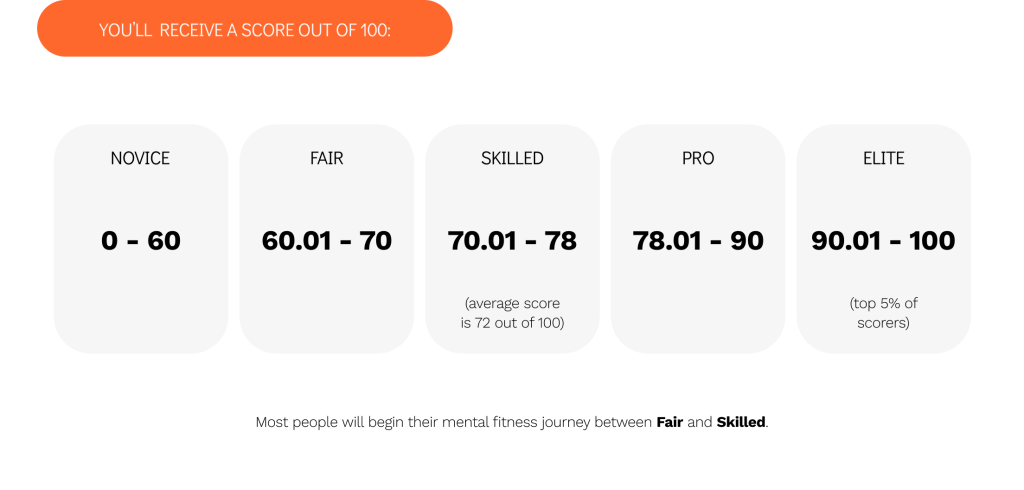
By understanding and harnessing the power of neuroplasticity, you can take control of your mental fitness journey and achieve a healthier, more fulfilling life. This mental fitness training guide is here to assist you every step of the way.
For more about the science behind your mental fitness score, download our white paper.
References:
- Neuroplasticity: https://www.ncbi.nlm.nih.gov/books/NBK557811/
- Robinson, P., Oades, L. G., & Caputi, P. (2015). Conceptualising and measuring mental fitness: A Delphi study. International Journal of Wellbeing, 5(1), 53-73. doi:10.5502/ijw.v5i1.4Paula
- Misra, S., & Stokols, D. (2012). Psychological and health outcomes of perceived information overload. Environment and Behavior, 44(6), 737–759. https://doi.org/10.1177/0013916511404408
- Kushlev, Kostadin & Proulx, Jason & Dunn, Elizabeth. (2016). “Silence Your Phones”: Smartphone Notifications Increase Inattention and Hyperactivity Symptoms. 10.1145/2858036.2858359.
- Twenge JM, Martin GN, Campbell WK. Decreases in psychological well-being among American adolescents after 2012 and links to screen time during the rise of smartphone technology. Emotion. 2018 Sep;18(6):765-780. doi: 10.1037/emo0000403. Epub 2018 Jan 22. PMID: 29355336.
- APA American Psychological Association. (2023). Stress in America™ 2023: A Nation Recovering from Collective Trauma.
- Office of the Surgeon General (OSG). Our Epidemic of Loneliness and Isolation: The U.S. Surgeon General’s Advisory on the Healing Effects of Social Connection and Community [Internet]. Washington (DC): US Department of Health and Human Services; 2023-. Available from: https://www.ncbi.nlm.nih.gov/books/NBK595227/
- Helliwell, John F., Richard Layard, Jeffrey Sachs, and Jan-Emmanuel De Neve, eds. 2020. World Happiness Report 2020. New York: Sustainable Development Solutions Network. Gallup World Poll
- Keyes CL. Promoting and protecting mental health as flourishing: a complementary strategy for improving national mental health. Am Psychol. 2007 Feb-Mar;62(2):95-108. doi: 10.1037/0003-066X.62.2.95. PMID: 17324035.
- Salovey, P., & Mayer, J. D. (1989-1990). Emotional intelligence. Imagination, Cognition and Personality, 9(3), 185–211. https://doi.org/10.2190/DUGG-P24E-52WK-6CDG
- Luthar SS, Cicchetti D, Becker B. The construct of resilience: a critical evaluation and guidelines for future work. Child Dev. 2000 May-Jun;71(3):543-62. doi: 10.1111/1467-8624.00164. PMID: 10953923; PMCID: PMC1885202.
- Diamond A. Executive functions. Annu Rev Psychol. 2013;64:135-68. doi: 10.1146/annurev-psych-113011-143750. Epub 2012 Sep 27. PMID: 23020641; PMCID: PMC4084861.
- Seligman ME, Csikszentmihalyi M. Positive psychology. An introduction. Am Psychol. 2000 Jan;55(1):5-14. doi: 10.1037//0003-066x.55.1.5. PMID: 11392865.
- Tugade MM, Fredrickson BL. Resilient individuals use positive emotions to bounce back from negative emotional experiences. J Pers Soc Psychol. 2004 Feb;86(2):320-33. doi: 10.1037/0022-3514.86.2.320. PMID: 14769087; PMCID: PMC3132556.
- Huppert, F. A. (2009). Psychological well‐being: Evidence regarding its causes and consequences. Applied Psychology: Health and Well-Being, 1(2), 137–164. https://doi.org/10.1111/j.1758-0854.2009.01008.x
- Cohen S, Gianaros PJ, Manuck SB. A Stage Model of Stress and Disease. Perspect Psychol Sci. 2016 Jul;11(4):456-63. doi: 10.1177/1745691616646305. PMID: 27474134; PMCID: PMC5647867.
- Diamond A, Lee K. Interventions shown to aid executive function development in children 4 to 12 years old. Science. 2011 Aug 19;333(6045):959-64. doi: 10.1126/science.1204529. PMID: 21852486; PMCID: PMC3159917.