
By Nicholas Singh, Founder of MindFit®. Reviewed by Phoebe Brosnan Hall, PhD.
TL;DR
- Mental fitness comes down to performing under pressure, and that has been hard to measure objectively.
- RSA reactivity is the objective measure: how far your nervous system dips when a stressor hits, and how fast it climbs back. It tracks the brain’s emotion-regulation circuits, and it responds to training.
- MindFit® trains that response the way resistance builds a muscle. Measuring it live is in beta now.
On this page: What is RSA? · What a stressor does to it · Why measure it under stress · The link to mental fitness · What the research says · How MindFit® trains it · FAQ
MindFit® built one of the first subjective assessments of mental fitness: the Mental Fitness Scale, a 27-item test you can take for free at mindfit.co/test. It is subjective. It asks you to report on yourself.
We want the objective side too: markers we can read straight off the body, no questionnaire involved. Mental fitness comes down to one thing: performance under pressure. So how do research labs actually measure that?
A few ways, each with a catch:
- EEG reads the brain directly, but the useful signals (event-related potentials) sit buried in noise and need a lab, many repeated trials, and heavy processing to pull out.
- Cortisol and other stress hormones can be measured, but they move slowly and peak long after the hard moment has passed.
- The heartbeat, read beat to beat, is fast, non-invasive, and something a wearable can already capture.
That last one is the opening, and it points to a single signal: RSA reactivity. Here is what it is, why it matters, and how we train it.
What is RSA?
Your heartbeat should dance. RSA, short for Respiratory Sinus Arrhythmia, is exactly that: your heart speeding up a little when you breathe in and slowing down when you breathe out. The bigger that breath-linked swing, the healthier the sign.
What drives it is your vagus nerve. Think of it as a brake pedal for your heart, running from your brainstem down to your chest. Every exhale, it presses the brake and your heart slows. Every inhale, it eases off and your heart speeds back up. RSA is the size of that swing: a big swing means a strong, responsive brake, a small flat one means the brake is barely moving.
What happens to RSA when a stressor hits
Watch one stressful moment from start to finish.
Before it arrives, you are calm. The brake is on, the swing is wide, RSA is high.
The moment it lands, your body ramps up to meet it. Heart rate climbs. RSA does the opposite: the brake releases, so the swing shrinks and RSA drops. This is the part that trips people up. The calming signal falls precisely because the system is revving, so RSA moves as the mirror image of heart rate. The drop itself is normal and useful, not a malfunction. A flexible mind drops in a measured way and stays in control. A fragile one crashes.
Once it passes, the brake comes back on and RSA climbs to where it started. The faster it returns, the better your recovery.
So how you handle pressure comes down to two things: how far RSA drops when the stressor lands, and how fast it climbs back. That pair is RSA reactivity.

Under stress, heart rate rises while RSA, the calming brake, falls. Both settle afterward. RSA reactivity is that fall and the speed of the climb back.
None of this is about staying calm. Too little response, a system that barely moves, looks like the flatness seen in depression. Too much, a system that spikes and cannot come back down, looks like anxiety. Mental fitness is the middle: a real response when the moment needs one, then a clean return.
Why measure it under stress
You cannot see any of that at rest. A resting reading catches you in the calm “before” and misses the part that matters, the response and the recovery.
This is why VO2 max, the gold standard for cardiovascular fitness, is never measured while you sleep. It is measured on a treadmill, under load, while you are pushing, because that is what shows how your body performs when it is challenged. RSA reactivity is the same idea for your nervous system. The resting number is the morning HRV score on your watch. Reactivity is the treadmill.
How does RSA connect to mental fitness?
Through the vagus nerve. It is the wiring between your brain and your heart, and it runs through the same circuits that regulate emotion. Thayer and Lane’s neurovisceral integration model treats this vagal heart rhythm as a peripheral readout of how well your prefrontal cortex is keeping your amygdala in check (Thayer and Lane, 2000). When that top-down control is working, you feel pressure without losing the plot. People with higher vagal control tend to perform better on demanding cognitive tasks, regulate emotion more effectively, and switch between mental sets more flexibly (Thayer et al., 2009).
The same system that paces your heart with your breath is the one you lean on to stay composed in a hard conversation. RSA gives you a window into it.
What does the research say?
RSA reactivity has served as an index of emotion-regulation efficiency under stress for decades. A few findings worth knowing.
A measured drop in RSA under stress is healthy. Easing off the vagal brake is how your body mobilizes to meet a challenge, and Porges describes that as an adaptive response (Porges, 2007). The warning signs are at the edges: a flat, blunted response, or a system that drops hard and then struggles to climb back. Both have been linked to depression (Rottenberg, 2007).
Recovery is one of the clearer signals. People who regulate well bounce back faster once a stressor passes. That return to baseline, sometimes called vagal rebound, reads directly on self-regulatory capacity, and it is impaired in people who struggle to regulate.
And it moves with training. This is the part that matters most for mental fitness. Slow-paced breathing reliably raises RSA, which is the basis of HRV biofeedback (Lehrer and Gevirtz, 2014). RSA reactivity and recovery have been shown to shift after interventions as different as cognitive behavioral therapy and aerobic exercise. The number is not a fixed trait you are stuck with. It responds to practice, the way a muscle responds to load.
Curious how mentally fit you are right now? The free Mental Fitness Test scores you across nine attributes in about five minutes.
How does a MindFit® workout train this?
A MindFit® workout runs you through that same before, during, and after, on purpose.
The warm-up is your before. A soundscape and slow, paced breathing set a clean, calm baseline.
The training is your during. You face a real stressful situation, simulated under a countdown, with pushback. This is the resistance: controlled stress, applied deliberately, the way a weight loads a muscle. Your breathing goes irregular on its own, because you cannot hold a steady breath while your prefrontal cortex is fully loaded. That is the point.
The cool-down is your after. No guided breathing, so the recovery you show is your own.
There is a name for why this works: hormesis. The right dose of stress strengthens a system, while too much harms it. Oshri’s hormesis model of resilience makes the case that controlled, moderate stress builds the capacity to handle more (Oshri, 2023). Run a MindFit® workout enough and the response trains: you meet pressure with a measured drop instead of a crash, and you come back faster. That is mental fitness you can build, the same way resistance builds a muscle.
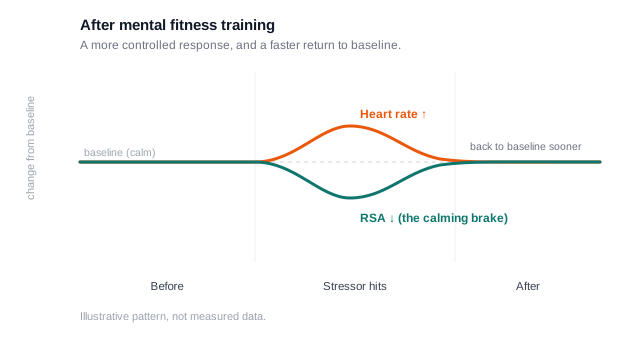
The trained pattern: a more controlled response, and a faster return to baseline. (Illustrative.)
Measuring it live is the next step, and it is in beta now. We are testing an integration with the Polar H10 chest strap that tracks your RSA reactivity curve and beat-to-beat intervals across the warm-up, the training, and the cool-down. As it matures, you will be able to watch your own before, during, and after, and see the recovery window shrink as you train.
You can feel the training yourself. Try a live exercise and put your own response under load.
Frequently asked questions
Is RSA reactivity the same as HRV?
They are related. RSA, RMSSD, and high-frequency HRV all track the same vagal activity in your heartbeat (Shaffer and Ginsberg, 2017). The difference is what you do with the measurement. Most HRV scores are taken at rest, as a morning snapshot. RSA reactivity is measured under stress: how your RSA changes when pressure hits, and how fast it recovers.
Can you train your RSA reactivity?
Yes. RSA is not a fixed trait. Slow-paced breathing reliably raises it (Lehrer and Gevirtz, 2014), and RSA reactivity and recovery have been shown to shift after interventions as different as cognitive behavioral therapy and aerobic exercise. It responds to practice, the way a muscle responds to load.
How is RSA measured?
RSA is calculated from the timing between your heartbeats across a breath, using an ECG or any sensor that captures beat-to-beat intervals. A chest strap like the Polar H10 captures it cleanly, and some wrist wearables can approximate it from their heart-rate sensor.
Does the MindFit® app measure my RSA yet?
Not in the public app. Right now the workouts train the response. Live RSA measurement is in beta, through a Polar H10 integration we are testing in our R&D.
What is a good RSA reactivity score?
There is no single universal number to hit. What matters is your own pattern over time: a flexible response when stress arrives, and a quick return to baseline once it passes. A flat, blunted response or a slow recovery are the signs worth watching (Rottenberg, 2007).
Sources
Lehrer, P.M., & Gevirtz, R. (2014). Heart rate variability biofeedback: how and why does it work? Frontiers in Psychology, 5, 756. https://doi.org/10.3389/fpsyg.2014.00756
Oshri, A. (2023). The hormesis model for building resilience through adversity: attention to mechanism in developmental context. Review of General Psychology. https://doi.org/10.1177/10892680221142020
Porges, S.W. (2007). The polyvagal perspective. Biological Psychology, 74(2), 116–143. https://doi.org/10.1016/j.biopsycho.2006.06.009
Rottenberg, J. (2007). Cardiac vagal control in depression: a critical analysis. Biological Psychology, 74(2), 200–211. https://doi.org/10.1016/j.biopsycho.2005.08.010
Shaffer, F., & Ginsberg, J.P. (2017). An overview of heart rate variability metrics and norms. Frontiers in Public Health, 5, 258. https://doi.org/10.3389/fpubh.2017.00258
Thayer, J.F., & Lane, R.D. (2000). A model of neurovisceral integration in emotion regulation and dysregulation. Journal of Affective Disorders, 61(3), 201–216. https://doi.org/10.1016/S0165-0327(00)00338-4
Thayer, J.F., Hansen, A.L., Saus-Rose, E., & Johnsen, B.H. (2009). Heart rate variability, prefrontal neural function, and cognitive performance: the neurovisceral integration perspective on self-regulation, adaptation, and health. Annals of Behavioral Medicine, 37(2), 141–153. https://doi.org/10.1007/s12160-009-9101-z